Transforming Legal Operations with Legal Contract Management
Legal Contract Management software is transforming contracts from static documents to dynamic data-driven assets. But can smart contract management turn complexity into clarity without compromising on the ideals? Can it speed of deals and still maintain profitability? Find out now!
-
 By
Sahil Arora
|
By
Sahil Arora
|
- • 15 min Read
Industry research confirms the high stakes. One IDC study found that inefficient contracting processes, an ideal case of ‘legal friction,’ can cost large firms an average of about $141 million per year in lost or delayed revenue. Another survey estimates that companies lose roughly 9% of annual revenue due to contract delays and missed renewals. For example, organisations report that contract review typically takes 92 minutes per document and that without automation inefficiencies eat 7–9% of profit. These are the situations where the need for a robust contract management practice that keeps an organisation compliant, efficient, and transparent arises, and to fulfil these requirements, the Legal Contract Management software comes into place.
In an era where speed and precision are paramount, Legal Contract Management software steps in – not merely as a legal necessity but as a strategic enabler. By leveraging advanced Contract Lifecycle Management (CLM) software, organisations can transform contracts from static documents into dynamic, data-driven assets that accelerate deal cycles, reduce risk, and enhance transparency. And here we discover just how that is done, when done right.
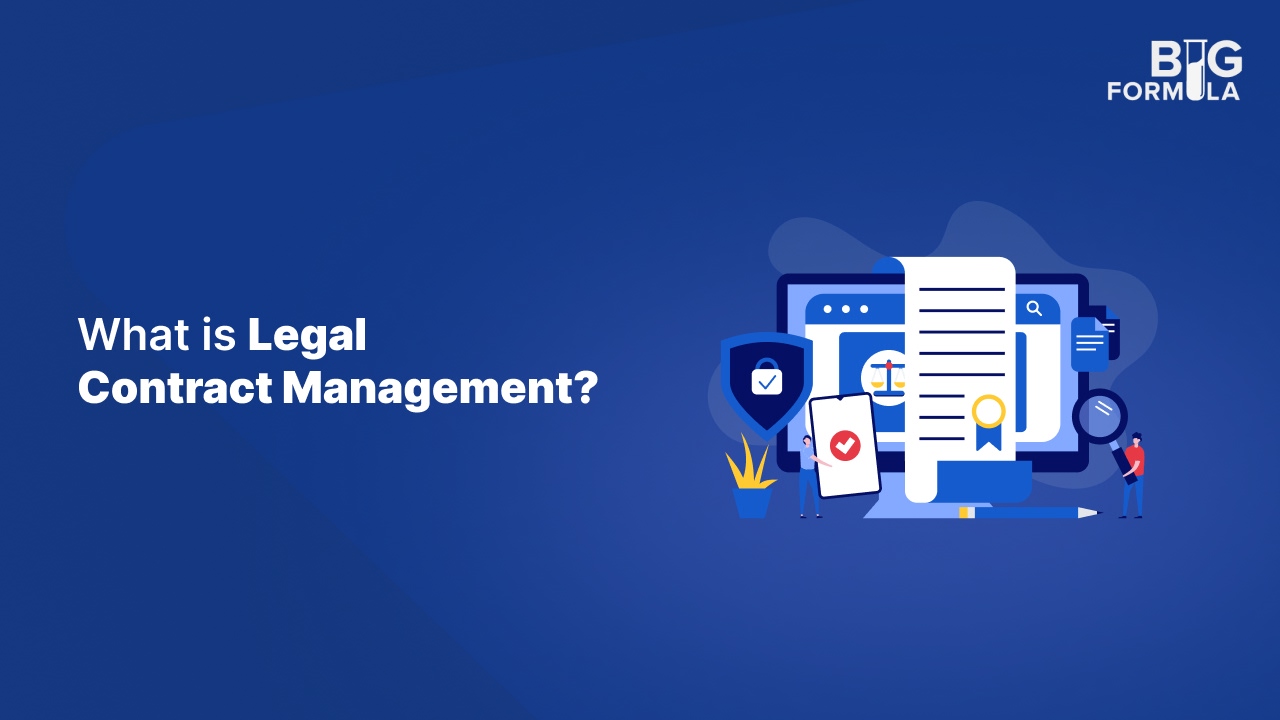
What is Legal Contract Management?
Bloomberg Law endows the definition of the term ‘contract management’ as merely ‘creating and overseeing a contract through its life cycle.’
The legal contract management process is the end-to-end process of creating, negotiating, approving, carrying out, and managing contracts to accomplish all requirements and minimise risks. In practice, this implies the systematic management of the legal contracts in their full scope. An effective contract management practice ensures that an organisation is compliant, efficient, transparent, and effective. It establishes clear processes (e.g., normal templates, approval pathways) and utilities.
Automation of specialised tools (also known as Contract Lifecycle Management or CLM Software) is frequently done for routine tasks. Current CLM systems are based on powerful technologies such as AI to extract key clauses, flag risks (e.g., unfavourable terms or missed obligations), and automate alerts and clauses. In short, legal contract management transforms documents into a business-driving data source, i.e., dynamic solutions, and also secures worth.
Key Elements of a Legal Contract
All contracts – simple purchase agreements or complex service-level contract – have some common basic elements. Those elements include:
- Key Parties and Information: This determines the purpose of involvement and essential information. The usual details are the names of parties, their role, the date of contract, signatures, and any approvals that were needed. It also discusses the background information (the reason the contract is in existence) and jurisdiction.
- Scope of Work: This specifies the content of delivery or performance. In this portion, the obligations, deliverables, and responsibilities of every party are spelled out. Effective scope eliminates confusion of expectations.
- Format and Templates: Consistent templates (e.g., of NDAs, SLAs, employment agreements) make sure that no critical section is skipped. Standardised templates assist in drafting quicker and on the part of legal teams, preventing mistakes. A contract management system commonly has certified templates, and therefore new contracts will automatically have mandatory sections.
- Terms and Clauses: The provision of substantive rules like payment conditions, warranties, termination rights, disclosure of information, and indemnities establishes legal requirements and solutions. Contract management implies the monitoring of all these clauses (to be in compliance) and ensuring changes are approved.
Legal Contract Management Lifecycle Stages
There is no definite list which describes the lifecycle stages of contract management; however, experts usually describe the cycle outlined in the following six-stage process:
| Stage | Phase | Description |
|---|---|---|
| 1 | Initiation | The legal team identifies the need for a contract and clearly defines its purpose and objectives. |
| 2 | Drafting & Negotiation | Contract terms are drafted, often using standard templates, and negotiated between the parties to finalize clauses. |
| 3 | Approval | The negotiated contract moves through an internal approval workflow involving legal teams and key stakeholders. |
| 4 | Execution | All required parties sign the contract, making the agreement legally binding. |
| 5 | Administration | The executed contract is monitored for compliance, obligations are tracked, and amendments are managed. |
| 6 | Renewal / Termination | Before expiry, the contract is reviewed to decide whether it should be renewed, renegotiated, or terminated. |
Common Challenges in Contract Management
Across industries, organisations continue to face a recurring set of challenges throughout the contract lifecycle – challenges that are operational in nature, but often carry legal, financial, and reputational consequences.
1. Data Confidentiality and Compliance Risks
Contracts contain privileged information, trade secrets, and sensitive business data. Without strong access controls and encryption, the risk of data breaches or unauthorised disclosures increases, potentially leading to litigation and reputational harm.
2. Lack of Audit Preparedness and Traceability
Poor documentation and weak version control complicate regulatory audits and legal discovery. Organisations often struggle to produce executed contracts, amendment histories, or approval trails, resulting in audit delays, compliance penalties, or adverse legal outcomes.
3. Cross-Functional Miscommunication
Contract management requires coordination between legal, procurement, and finance teams. When processes are siloed, miscommunication leads to duplicated effort, missed updates, and inconsistent decision-making.
4. High Contract Volume and Limited Legal Resources
Legal teams are expected to manage growing contract volumes without corresponding increases in staff. This imbalance causes delays, increases burnout, and limits the depth of legal review – particularly for high-risk clauses.
5. Manual Review and Lack of Automation
Clause-by-clause manual review remains one of the most time-consuming tasks. Reliance on manual processes slows turnaround times and increases the risk of overlooking non-standard terms or critical risk clauses, while consuming valuable legal bandwidth on repetitive work.
6. Absence of Performance Metrics and KPIs
Many departments focus on execution speed rather than measuring outcomes. Without defined metrics such as contract cycle time, deviations from standard terms, or dispute frequency, inefficiencies remain largely invisible.
The Key Lies with Legal Contract Management Softwares
Modern legal contract management software addresses these challenges by introducing structure, visibility, and control across the entire contract lifecycle, transforming contracts from operational bottlenecks into manageable business assets.
Centralised Contract Repository
The software stores all contracts in a single, secure, and searchable repository, making retrieval fast and reliable. This eliminates scattered files, reduces the risk of lost documents, and significantly improves accessibility across teams.
Automated Workflows & Approvals
Review, approval, and signing workflows are automated, including notifications and electronic signatures. This streamlines contract progression, reduces manual follow-ups, and shortens approval cycles.
Template & Clause Libraries
Pre-approved templates and clause libraries enable faster, more consistent drafting. Standardisation ensures contracts align with legal and regulatory requirements while minimising drafting errors.
Version Control & Negotiation Tracking
All edits and revisions are tracked throughout negotiations, creating a clear audit trail and avoiding version confusion. Legal, sales, procurement, and finance teams can collaborate within a single system, improving cross-functional coordination.
Advanced Search & Reporting
Powerful search capabilities allow contracts to be located by keyword, clause, party, or obligation. Reporting and analytics provide insights into contract performance, risks, and trends.
Integration with Other Systems
The software integrates with CRM, ERP, and e-signature platforms, ensuring contract data remains consistent and up to date across departments and business systems.
Deadline & Renewal Tracking
Automated alerts notify users of key milestones, expirations, and renewal dates. This helps prevent missed deadlines and supports proactive contract management.
Data Privacy
Contracts are protected through strong encryption and controlled access permissions. Compliance measures are embedded into the system to safeguard sensitive legal information and meet data protection standards.
When Legal Efficiency Meets Business Expertise
In today’s contract-driven business environment, legal efficiency is no longer just a matter of risk containment – it is a direct contributor to business performance. As contract volumes grow and transactions become more complex, manual processes and fragmented tools struggle to keep pace. This is where modern Contract Lifecycle Management (CLM) systems step in, bringing structure, visibility, and intelligence to every stage of the contract journey.
Advanced CLM platforms unify drafting, negotiation, approval, execution, and renewal within a single, secure framework. By combining standardised templates, automated workflows, e-signatures, and real-time insights, they help legal teams move faster without compromising accuracy or compliance. More importantly, they connect legal operations with sales, procurement, and finance, ensuring contracts support business momentum rather than slow it down.
Solutions such as BIGFORMULA’s CLM sit within this broader shift, illustrating how the right technology can transform contracts from static documents into active business assets. When implemented thoughtfully, CLM enables legal teams to move beyond reactive firefighting towards proactive, insight-led governance.
The result is a more agile organisation – one that closes deals with confidence, mitigates risk early, remains audit-ready, and aligns legal decision-making with commercial goals. When legal efficiency meets business expertise, contract management becomes not just a safeguard, but a source of sustainable competitive advantage.